.webp)

 Call: (+1) 571-888-5202
 Mail: [email protected]
Every hire is a calculated risk. You commit salary, benefits, and onboarding time to someone you have only met in a few interviews. When it works, it's great. When it doesn't, the cost of a bad hire shows up in missed deadlines, team turnover, and a second search you did not budget for.
That's why more procurement leaders, HR heads, and hiring managers are building contract-to-hire into their workforce planning. It lets you test the fit before you commit. But it is not right for every role, and used carelessly it can cost you top talent.
This guide covers how it works, where it wins, where it falls short, and how to decide.
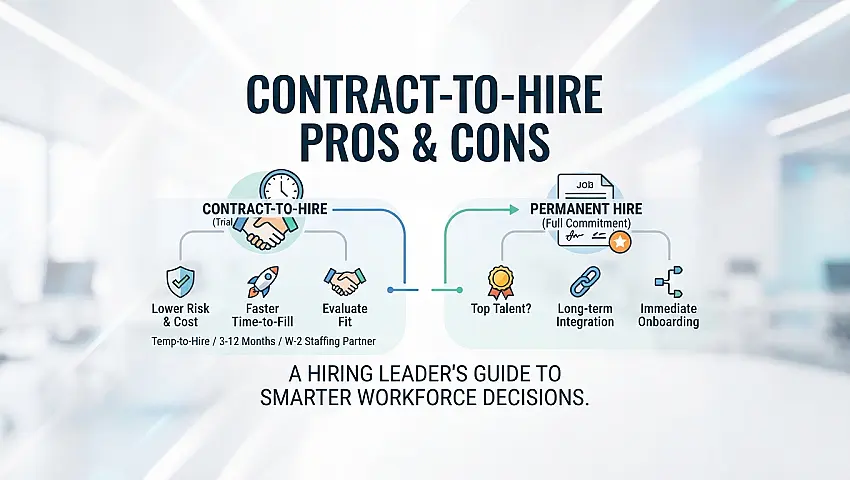
Quick Answer: Contract-to-hire (also called temp-to-hire or contract-to-perm) is a staffing model where a candidate works as a contractor on a staffing partner's W-2 payroll for a set period, usually 3 to 12 months. You then decide whether to convert them to a full-time employee. It lowers hiring risk and speeds up time-to-fill, but it can deter top candidates who want job certainty.
Contract-to-hire is a trial period with a job offer at the end. Your staffing partner sources, screens, and places a candidate. During the contract, the candidate works inside your team while the agency manages payroll, payroll taxes, and compliance. At the end of the assignment, you can:
These are not the same, and the difference matters for compliance.
|
Contract-to-Hire
Worker |
Independent
Contractor |
|
|
Tax
status |
W-2
employee of the staffing firm |
1099,
self-employed |
|
Path to
permanent role |
Yes,
built in |
No |
|
Who
handles payroll |
Staffing
partner |
The
contractor |
|
Day-to-day
integration |
Embedded
in your team |
Project-based,
more autonomous |
Getting this wrong can lead to worker misclassification penalties, so align HR, Legal, and Procurement before launching any program.
Interviews show how someone presents. Contract work shows how they perform under pressure, communicate when things go wrong, and fit your team. That is the strongest hiring signal you can get.
During the contract phase, the staffing partner carries payroll taxes, workers' compensation, and benefits administration. That helps when headcount approvals are conditional or budgets are tight.
Your staffing partner handles sourcing and screening, so your team spends time on finalists and not on filtering. In a competitive market, faster placement means faster productivity.
Projects shift and funding changes. Contract-to-hire lets you add capacity without a permanent commitment before the picture is clear.
When both sides have evaluated the fit over months, the hires who convert tend to stay. That improves the quality of your permanent workforce over time.
Strong candidates with multiple offers may favor a direct hire. For hard-to-fill skills, consider whether this model costs you the shortlist.
A contractor unsure about their future has less reason to invest in relationships. Treat them like a future employee from day one: include them in meetings, give them context, and set clear conversion criteria.
How you direct and manage a contractor affects legal exposure. Rules vary by state and province, so have Legal and your staffing partner review the arrangement before launch.
If someone is clearly exceptional, don't wait for the contract end date. Early conversion often beats losing them to a competing offer.
A contract that runs well past its planned window can add up. Set a conversion decision date and stick to it.
Think twice about this model for:
|
Factor |
Contract-to-Hire |
Direct Hire |
|
Time-to-fill |
Typically faster |
Typically slower |
|
Upfront
cost |
Lower |
Higher |
|
Hiring
risk |
Lower |
Higher |
|
Candidate
pool |
Slightly narrower |
Broader |
|
Long-term
cost |
Can exceed direct hire if extended |
More predictable |
|
Best
for |
New, uncertain, or evolving roles |
Critical, permanent roles |
Simple rule: When a wrong hire would be catastrophic, go direct hire. When moving slowly costs more than being wrong, go contract-to-hire.
How long does a contract-to-hire assignment last?
Most last 3 to 12 months. Shorter terms suit roles where skills are quick to evaluate, and longer terms suit complex or senior roles.
Who pays the worker during the contract?
The staffing partner does, since the worker is their W-2 employee. You pay the agency a bill rate that covers wages, taxes, benefits administration, and the agency's margin.
What is a conversion fee?
A conversion fee is what a staffing firm charges when you hire its contractor as a permanent employee. Terms vary, and many agreements reduce or waive the fee after a set number of contract hours. Always confirm terms in the agreement up front.
Can I end a contract-to-hire arrangement early?
Usually yes, with notice. Check minimum engagement periods and conversion terms before signing.
Is contract-to-hire the same as temp-to-hire?
The terms are used interchangeably. Both describe a trial assignment with a path to permanent employment. Some use "temp-to-hire" for shorter or lower-skilled assignments.
Is contract-to-hire better than direct hire?
Neither is better in every case. Contract-to-hire fits uncertain or evolving roles, and direct hire fits critical permanent roles.
What should procurement teams evaluate in a contract-to-hire staffing partner?
Look for transparent bill rates and conversion fee terms, strong compliance practices, a proven screening process, industry-specific expertise, and the ability to scale across locations.
Contract-to-hire works best when your staffing partner understands your roles, your culture, and your compliance needs. PeopleNTech LLC is an NMSDC-certified Minority Business Enterprise (MBE) that combines AI-enabled talent sourcing with hands-on recruiting expertise to deliver workforce solutions across the US and Canada. We help you:
Ready to hire smarter? Talk to our team about your open roles.
📞 (+1) 571-888-5202 | ✉️ [email protected] | 🌐 www.peoplentech.com
Let's build your team, and make PeopleNTech your hiring partner.
.webp)