
 Call: (+1) 571-888-5202
 Mail: [email protected]
A CFO we worked with once asked her leadership team a deceptively simple question: "How many people actually work for us?"
Nobody could answer.
HR had a headcount number. Finance had a contractor spend line. Procurement had a vendor list. The PMO had a stack of statements of work nobody had reconciled in months. Five departments, five numbers, zero agreement.
That's not a data problem. That's a structural one. Most companies today don't run one workforce — they run four or five, each behind its own door, each managed by a different team, on a different system, with a different set of rules.
In 2026, closing those doors and building one unified view isn't a nice-to-have anymore. It's the difference between organizations that can move fast and organizations that find out too late they couldn't.

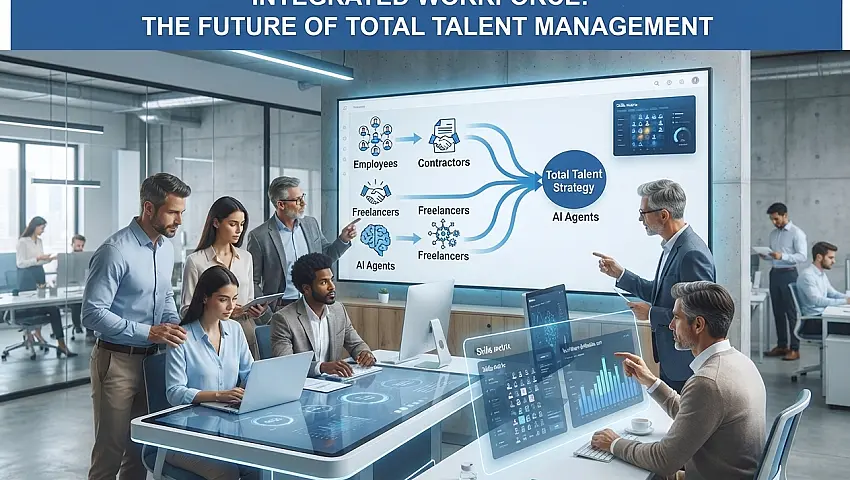
Talk to enough HR and talent leaders and a pattern shows up every time. The modern workforce isn't one group of people. It's a blend of:
Four different doors. Four different ways of sourcing, managing, and paying people. And in most organizations, four different teams who barely talk to each other about any of it.
Total talent management is the discipline of treating all four as one strategy instead of four separate headaches. It doesn't erase the differences between an employee and a freelancer — it just means leadership can finally see all of them on one screen, plan for all of them together, and stop quietly paying twice for the same skill set.
Three shifts pushed total talent management from "someday" to "now."
Work itself broke apart. Forward-thinking organizations no longer plan headcount as one number. They plan output — and increasingly, that output is delivered by a mix of employees, contractors, freelancers, and AI systems working side by side.
Hiring went skills-first. A large majority of employers have shifted toward skills-based hiring. That approach only works if skills are visible everywhere talent lives — not just inside the employee roster. A contractor with a rare, high-demand skill is invisible to a recruiting team if she's sitting in a system HR was never given access to.
AI raised the bar on speed. With AI now embedded across the hiring process at most organizations, finding candidates got faster almost everywhere. The bottleneck moved. It's no longer about finding talent — it's about coordinating it once you've found it. Speed without visibility just produces chaos at a faster pace.
This is the part that gets finance leaders' attention. A fragmented workforce isn't just inconvenient. It's expensive, and the expense compounds quietly until something forces the issue.
When permanent hiring, contingent staffing, and SOW-based spend each run on separate rails, the same failures show up in every channel: duplicate sourcing efforts, duplicate vendor fees, compliance gaps that surface right when an audit lands, and an organization that simply cannot flex headcount up or down when the market demands it.
Siloed Workforce
Total Talent Management

Most companies don't discover this cost until something forces the conversation — a misclassification penalty, a failed audit, or a hiring freeze where nobody can say with confidence which contractors are still active on the books. Total talent management is, in large part, simply the decision to stop paying that hidden tax.
You don't arrive at total talent management by buying a piece of software. You get there with a deliberate sequence — and the order matters more than most leaders expect.
1. Map every worker. Before optimizing anything, inventory all four channels: full-time employees, contingent staff, SOW-based talent, freelance and gig workers, and any AI agents doing real work. You cannot manage a workforce you can't see in full.
2. Unify visibility. Bring every channel under one operating layer — typically through an MSP or VMS partner feeding a single shared dashboard — so every leader is working from the same source of truth instead of five conflicting spreadsheets.
3. Lead with skills, not job titles. Tag talent by capability across every channel so the right person surfaces for the need, whether that person is a full-time employee, a contractor, or a freelancer three time zones away.
4. Centralize governance and compliance. One model for worker classification, co-employment risk, and cross-border payroll beats fifteen regional workarounds — especially for organizations hiring across multiple countries.
5. Measure what actually matters. Track quality of hire, total workforce cost, and organizational agility — not just time-to-fill. Real maturity shows up in business outcomes, not vanity metrics.
Skip step two and your skills strategy has nothing solid to draw from. Skip step four and every dollar you saved evaporates the moment a regulator comes calling.

Organizations that build a real total talent strategy stop asking "can we even find this skill?" They start asking, "which channel gets us this skill the fastest and most cost-effectively?"
Workforce planning stops being an annual guessing exercise and becomes a living model that adjusts as the business does. When conditions shift — a new product line, an unexpected downturn, an acquisition — the organization scales in days instead of quarters.
That agility is the actual prize. The talent challenges ahead won't be solved by hiring harder through a single door. They'll be solved by organizations that learn to find, blend, and govern talent across all of them, deliberately, as one strategy.

Every organization already has five front doors into its workforce. The only real question is whether those doors are being managed as one coordinated strategy — or five separate accidents waiting to be discovered by an auditor.
At PeopleNTech, this is the work we do every day. As an AI-enabled talent sourcing and workforce solutions partner serving clients across the US and Canada, we help HR and talent leaders unify direct hire, contingent, SOW, and gig talent under a single, skills-first strategy — backed by compliant, scalable sourcing built for exactly this kind of complexity.
As a certified Minority Business Enterprise (MBE), PeopleNTech also brings supplier diversity value to every engagement, alongside our full portfolio of workforce solutions: direct hire, staff augmentation, RPO, MSP, and AI-enabled sourcing.
Ready to see your entire workforce on one screen? Talk to the PeopleNTech team about building your total talent management strategy.
What is total talent management? Total talent management is a workforce strategy that plans, sources, and governs every type of worker — full-time employees, contingent staff, SOW-based contractors, freelancers, and AI agents — under one unified approach instead of separate, disconnected processes.
Why is total talent management important in 2026? Work is increasingly delivered by a blend of employee, contingent, freelance, and AI-driven labor. Without a unified strategy, organizations face duplicate spend, compliance gaps, and an inability to scale quickly when business needs change.
What's the first step to building a total talent strategy? Start by mapping every worker across all talent channels — employees, contingent staff, SOW talent, gig workers, and AI agents — so leadership has full visibility before building governance or skills-matching processes on top of it.
How does PeopleNTech help with total talent management? PeopleNTech provides AI-enabled talent sourcing and workforce solutions — including direct hire, staff augmentation, RPO, and MSP support — that give HR leaders a single, skills-first view across their entire workforce.
.webp)
.webp)