
 Call: (+1) 571-888-5202
 Mail: [email protected]

"We need to hire someone." It's the sentence that kicks off almost every staffing conversation. But ask a follow-up question — who exactly, and why — and the answer often gets fuzzy fast.
At PeopleNTech, this is the first gap we help clients close. Your hiring needs aren't just a list of empty seats. They're a reflection of where your business is headed, what your teams are capable of today, and what your culture needs to thrive tomorrow. Skip this step, and you risk hiring fast but hiring wrong.
Here's a practical framework for defining your hiring needs the right way, before a single job description goes live.
Defining your hiring needs means identifying not just which roles are open, but why they matter, when they need to be filled, and what success looks like once someone is in the seat. It connects recruitment to business strategy instead of treating hiring as a reactive fire drill.
Done well, this process touches four areas: operations, growth, culture, and skills. Done poorly, it leads to mismatched hires, rising turnover, and recruiting cycles that never seem to end.
Every organization has roles that are non-negotiable to daily operations. Clearly defined hiring needs make sure those seats are never left empty long enough to disrupt service delivery, client commitments, or production timelines.
Unfilled or poorly defined roles don't just sit empty — they get absorbed by the people already on your team. That's a fast track to burnout, disengagement, and the kind of turnover that costs far more than the hire you delayed making.
Hiring needs shouldn't only reflect today's org chart. The strongest workforce plans look 12 to 24 months ahead, anticipating the roles a growing business, a shifting market, or new technology will demand next.
When hiring needs are vague, hiring managers fall back on gut instinct. When they're specific — skills, experience, mindset, credentials — recruiters know exactly what to source for, which shortens time-to-fill and improves match quality.
Every hire either reinforces your culture or chips away at it. Defining your hiring needs forces clarity on the kind of people, not just the kind of skill sets, your organization wants to grow with.
Hiring needs that belong to "everyone" end up belonging to no one. Decide upfront whether HR, department leaders, or a workforce solutions partner like PeopleNTech will own the process, along with who has final say on candidate decisions. Settle this before a role opens, not after.
Every hiring decision should trace back to a business goal. Are you scaling a department, entering a new market, or stabilizing a team that's stretched thin? Understanding organizational priorities first prevents recruiting for roles that sound good but don't move the business forward.
Look honestly at team capacity. Where are people overextended? Where is talent underutilized? Are certain roles becoming less critical as technology or processes evolve? This audit often reveals hiring needs that weren't obvious from the org chart alone.
Across industries, the gap between the skills companies need and the skills their workforce currently has is widening fast. A structured skills gap analysis shows you exactly where to hire externally versus where internal upskilling makes more sense.
Business direction, market shifts, and new technology all reshape future hiring needs. This is where AI-enabled workforce planning adds real value: modeling different growth scenarios so you can anticipate hiring needs instead of reacting to them once they become urgent.
Not every hire carries the same urgency. Rank roles by both business impact and timeline, so recruiting resources go first to the positions that matter most right now, while others stay on the radar for the near future.
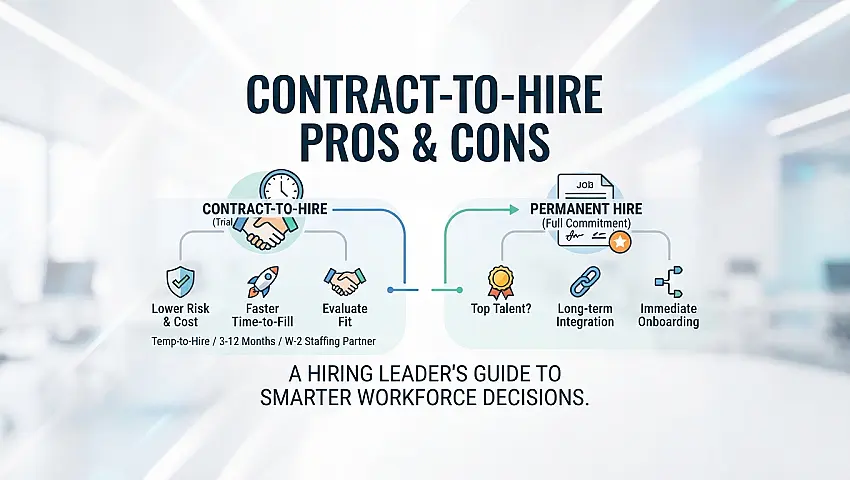
Finally, translate priorities into specifics: required skills, experience, credentials, and the employment model that fits — full-time, contract, or contract-to-hire. The clearer the criteria, the more aligned your candidate pipeline will be with what your business actually needs.
What are hiring needs? Hiring needs are the specific roles, skills, and headcount a business must fill to meet its operational, growth, and culture goals, defined by urgency, timeline, and required qualifications.
Why is it important to define hiring needs before recruiting? Defining hiring needs first prevents mismatched hires, reduces time-to-fill, and ensures every new hire supports a clear business priority rather than filling a seat reactively.
How often should a company reassess its hiring needs? Most growing organizations benefit from revisiting hiring needs quarterly, alongside a longer 12-to-24-month workforce forecast, to stay ahead of skills gaps and market shifts.
Who should own the hiring needs process? Ownership should sit with a single, clearly identified group — HR, department leadership, or an outsourced talent partner — rather than being shared informally across the organization.
Defining your hiring needs is the foundation of every successful workforce strategy, and it's exactly where PeopleNTech's AI-enabled talent sourcing expertise makes the difference. As a certified Minority Business Enterprise (MBE) serving organizations across the US and Canada, we help you go beyond headcount to build a workforce strategy rooted in your real business priorities — from direct hire and contract staffing to executive search and full-scale workforce solutions.
Ready to define your hiring needs with confidence? Connect with PeopleNTech today and let's build a hiring strategy that grows with your business.
.webp)
.webp)